
Monthly billing for a home child care agency
Home agency billing has two sides: what families owe for care, and what the agency owes the home operator. They share information about the children and care dates, but they answer different questions.
This guide is for the agency team running billing. Home operators looking for an explanation of their statement can start with home remittance and adjustments.
Set up each home before billing
Section titled “Set up each home before billing”Check the home’s billing cycle policy, program tuition and service-day policy. Confirm that the home has the correct remittance policy and that its operator details are up to date.
Then check each child’s attendance schedule, billing contact, guarantee and subsidy. Those details help explain both the family charges and the care included in the home’s calculation.
Our Cedar Lane example has three children: Maya and Amira attend Monday to Friday, while Theo attends Monday, Wednesday and Friday. Maya has a subsidy; Amira has a price guarantee through December.
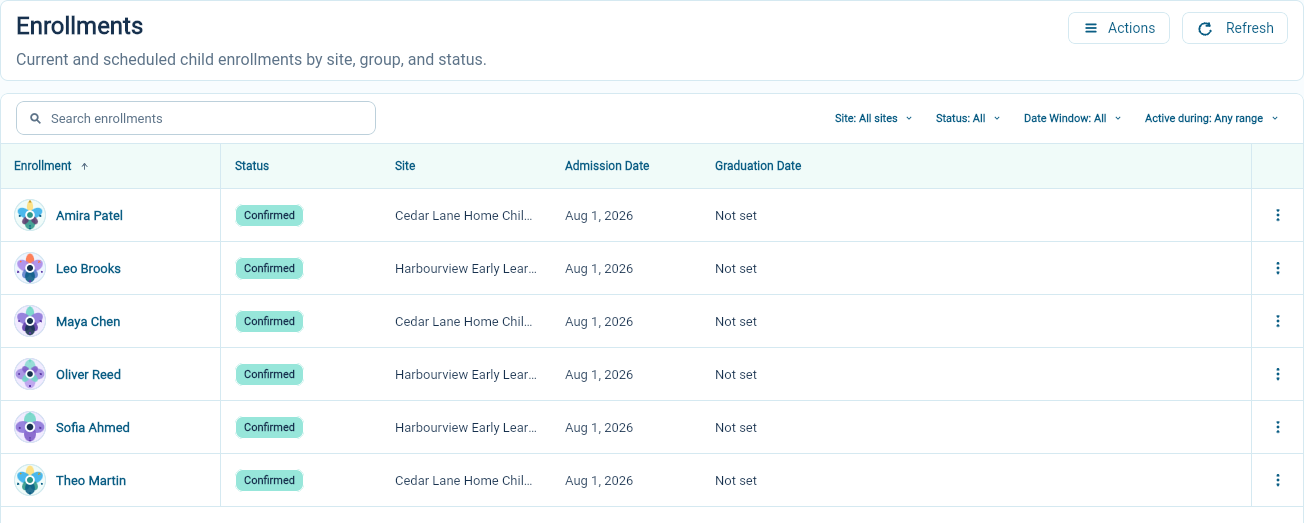
These example enrollments let the guides show different schedules and funding arrangements. Check the site when working from a list that includes several locations.
Review the home’s calendar
Section titled “Review the home’s calendar”Before the first bill, review the home’s holidays, planned closures and notice dates. Its service-day policy determines which scheduled days are paid.
A closed day can affect several children differently because they do not all attend on the same weekdays. It can also affect the remittance calculation, so the calendar deserves attention on both sides of the bill.
See billable days and closures.
Check both totals in the preview
Section titled “Check both totals in the preview”Open the home’s period in Billing Cycles and review the provisional preview. Check the children’s amounts, parent invoices and remittance payable.
In our saved Cedar Lane August example:
| Record | Example total |
|---|---|
| Tuition charges | $3,281.00 |
| Three parent invoices | $1,042.00 |
| Home remittance payable | $3,704.34 |
These totals are different for a reason. Parent invoices cover the families’ shares after funding. Home remittance follows the home’s policy, including its additional amounts and adjustments. It is not calculated by simply adding the parent invoices together.
The figures above are example results, not standard agency rates or a recommended remittance formula.
Run the billing and review the result
Section titled “Run the billing and review the result”When the preview is right, run provisional billing. Check that the expected parent invoices and home remittance records were created.
The remittance advice explains the calculation. The payable records what the agency owes. Neither, on its own, confirms that money has been transferred to the home operator.
Prepare and run a billing cycle gives the shared steps.
Reconcile before moving on
Section titled “Reconcile before moving on”At the end of the period, review actuals. A late unpaid closure may change the family charges and the home’s amount. Home remittance differences are carried into a later provisional remittance.
Check the previous cycle’s outstanding work before running the next one. In the Cedar Lane example, September still awaits completion of the earlier reconciliation; an empty September total does not mean no payment will be due.
For the parts of the home’s calculation and the meaning of carried balances, continue to home remittance and adjustments.